One Sunday morning in February 1997, Jacqueline Miller was standing on a stool hanging curtains in her son’s room. The last thing she remembers before she found herself covered in blood on the floor is beginning to get down off the stool. “We figured out later that I must have lost my balance, “ she says. “I had apparently hit my face — hard — on the corner of my son’s desk.” The impact had severely injured her spinal cord in the area of her neck and she would need 150 stitches for the lacerations in her face.
Jackie’s spinal cord injury had transformed her in an instant from an outdoor enthusiast, scientist and mother of two young boys to someone who could not walk, turn a page or feed herself. The prognosis was grim: Doctors told her that she would be permanently paralyzed below her waist, with minimal movement in her arms and hands. “One of my doctors told me that the best recovery I could hope for was to be able to eventually shuffle 10 feet down the aisle — with a walker — at my son’s wedding,” says Jackie, adding quickly, “They were wrong.” When the extent of the traumatic injury finally sank in, Jackie was in shock and disbelieving. “All I wanted to be able to do was hug my children,” she says. “And I couldn’t even do that.”
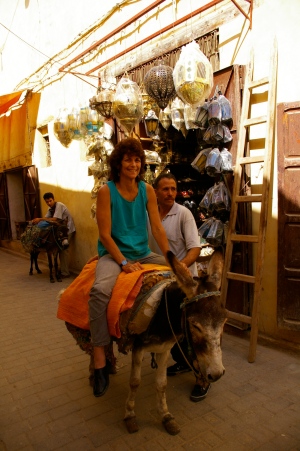
Those who know Jackie best describe her resilience and determination, and these two qualities, along with her sense of humor, have helped her reclaim her life. She is back at work “more than” full-time and recently got back from a trip to Rome and Morocco with her husband. Her son called the donkey “Mom’s Moroccan wheelchair.”
This is the first in a series called “Stories of Hope: Pathways to Healing,” since we all need hope, especially when faced with a catastrophic injury or a frightening diagnosis. Do you have a story to share?
– Here are pictures of Jackie on her trip; She had been told she would be quadriplegic:

Jacqueline Miller took the best that conventional rehabilitative medicine had to offer and then struck out on her own in search of alternative and complementary therapies. “Conventional rehab just didn’t go far enough,” she says. With a Ph.D. in molecular biology and a background that includes teaching at Harvard Medical School, developing high school science curricula and training teachers to use it, Jackie is naturally both curious and creative. It is this restless, seeking energy that still drives her to accept nothing less than full recovery. “Even though I am a conventionally trained scientist,” says Jackie, “I am open to the healing possibilities of other methods of treatment.” Even before she was discharged from the hospital, Jackie asked a Chinese medicine expert she knew to come and give her acupressure and Shiatsu massage treatments. “From the Chinese medicine perspective, the meridians (invisible pathways) that carry the Qi (life force or energy) were completely blocked from the injury,” says Jackie. “The blood flow was blocked as well. Acupressure massage at the site of the injury and throughout the body helps to move the blood and Qi, which helps with circulation and may help with the paralysis as well. This doesn’t happen quickly, it takes time.” The regular massage also helped to release muscles that had gone into spasm as a result of the injury. At the same time, Jackie’s doctors were also giving her high doses of cortisone to reduce the inflammation.
Jackie continued the Traditional Chinese Medicine treatments after her return home, adding acupuncture as well, while continuing her physical therapy. Soon, however, her rehabilitation benefits were terminated. “When they cut off my coverage for physical therapy because they thought I’d never walk again, my first reaction was despair,” says Jackie. “Who would teach me to walk? My family? It was unthinkable that I would not walk. Then I finally had an idea: Why not a professional trainer?” This is when Susan Himmelman came into Jackie’s life.
As a physical education teacher and coach turned personal trainer, Susan E. Himmelman, M.S., knows how to help people move. When Jackie contacted her, she was intrigued. “I had taught motor skills to thousands of children,” says Susan. “But I had never worked with someone who had been totally paralyzed from a spinal cord injury. It would be a challenge.”
Susan started working with Jackie in September 1999. “When I met Jackie, she could not even stand for a second on her own. Her hands were curled up like claws. She had no balance and, because of all the time in a wheelchair, her hip, thigh and calf muscles had become so short from the constant sitting that she could not stand upright even with support. The range of motion in her ankles had decreased so much that she had difficulty getting her heels onto the floor when she tried to stand up.”
Susan was undaunted. “I saw these first as mechanical problems that could be corrected by stretching, massage and strengthening,” she says. “At the same time, we would work on reeducating healthy nerve cells in the brain and spinal cord to send the right messages to those muscles. I saw no reason why I could not teach her how to walk again. Perhaps I didn’t know enough to get discouraged or quit.”
Susan worked with Jackie to help her find her balance while sitting, then standing, and then while trying to catch a ball. “I don’t think of Jackie as a handicapped person,” explains Susan. “I think of her as a person who needs to be taught motors skills. My job is to find the nerve pathway that the brain and spinal cord use to send messages to the muscles — and make sure that the correct messages get sent, either by blocking the wrong messages or by creating new ones. Then we enhance the ‘motor memory’ through constant repetition — the way a baby does — until the correct nerve pattern is established.” In Susan’s opinion, the leg braces that had been prescribed for Jackie were shortcuts, and not very effective ones. “It seems to me, if you’re going to teach a motor skill, you need to use the proper biomechanics. And with heavy braces holding the legs rigid, the muscles will never learn on their own.”
Susan’s methods worked. Jackie no longer wears the leg braces and can now occasionally dispense with the two canes and walk holding onto Susan’s hands. Her current distance is a quarter of a mile, but she expects that to increase (a far cry from the 10-foot “walker shuffle” that her doctors predicted would be her limit). She can type again, using two fingers, answer the phone, drive, cook, and do her job designing science curricula once again. She has also changed her choice of medical providers: “Most of the conventional doctors who treated me after my injury rarely looked me in the eye and tended to see me as a collection of symptoms, rather than a whole person. Since then, I have only chosen doctors who are open-minded to the connection between mind, spirit and body, and who practice a more holistic form of medicine.”
5 Comments
December 16, 2008 at 8:10 am
Thank you so much for posting this story. I needed to hear this. We’re at a discouraging point with my RSDS/CRPS right now and I feel quite alone and afraid. This story gives me some hope that maybe some day, I will feel better.
December 16, 2008 at 12:44 pm
Your post means a lot to me. I had decided to write a series of these “stories of hope” for exactly the reasons you describe. We all need to have hope, especially when things seem darkest.
December 24, 2008 at 9:38 pm
This is a terrific story that highlights what hope can do. I’m going to link to it in my next blog post on HOPE.
January 9, 2009 at 3:21 pm
Jackie,
I would VERY much like to be in communication with you. I am an OT having a diagnosis of MS who is recovering from a tramatic hip fracture. I will be returning to work as an OT shortly as well as own and opportate my own business. It would be great to be in touch. I look forward to hearing from you.
Sincerely,
rhonda
April 15, 2009 at 11:38 am
I follow your posts for quite a long time and should tell that your articles are always valuable to readers.